
Spending remains strong, but consumer caution continues to shape a difficult backdrop for businesses. These conditions favor companies that can sustain demand without relying on strong consumer confidence. In today’s FA Alpha Daily, we examine how Restaurant Brands (QSR) is positioned for this setup and why investor concerns may be overstated.
FA Alpha Daily
Powered by Valens Research
Consumer sentiment is in a strange, in-between phase right now.
While consumer confidence based on the University of Michigan’s Consumer Sentiment Index edged slightly higher in January, it also indicated customers are still adopting a cautious approach toward the job market and the overall condition of America’s business sector.
Moreover, households are still worried about inflation and job uncertainty.
Yet despite this gloomy backdrop, spending has yet to fall apart completely. Real personal consumption expenditures as of September 2025 reached an all-time high of $16.6 trillion.
This combination of weak sentiment and steady spending creates an unusual environment where consumers could move in either direction, making things very difficult for businesses. And unfortunately, very few businesses thrive when consumers feel squeezed.
Fortunately, this dynamic plays well to the strengths of Restaurant Brands (QSR), a leading player in the quick-service restaurant industry,
The company, headquartered in Canada, operates over 32,000 restaurants in more than 120 territories across the globe. It only lags behind McDonald’s (MCD), Starbucks (SBUX), and Subway in terms of locations.
Restaurant Brands was formed in 2014 following the $12.5 billion merger of American chain Burger King and Canadian coffee brand Tim Hortons. In 2017, the company added Popeyes to its portfolio, before acquiring Firehouse subs in 2021.
The quick-service restaurant firm is uniquely positioned because it owns brands that offer consumer staples like coffee and affordable breakfast, lunch, and dinner meals.
This means that when the economic situation goes from healthy to uncertain and consumer sentiment goes from confident to weak, the company will hold up well because diners will simply trade down from higher-priced options to more affordable ones.
Since 2017, Restaurant Brands has grown its store base from 24,000 to 32,000 while revenue has more than doubled from $4.5 billion to $9.2 billion as of September 2025.
Restaurant Brands’ biggest advantage doesn’t just stem from its market positioning but also from how its business is built.
The company operates on a franchise-based model, enabling it to scale quickly without deploying massive amounts of capital, all while maintaining strong profitability.
Uniform Accounting shows just how profitable this company is despite the challenges it faces.
From 2016 to 2024, the company delivered an average Uniform return on assets (“ROA”) of 40%, more than triple the corporate average. Meanwhile, asset growth for 2024 reached 16%.
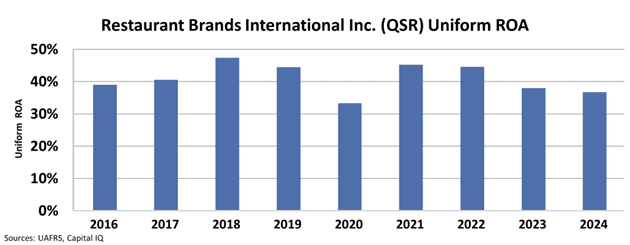
Yet despite its strong profitability, the company trades at a Uniform P/E of 15.7x, below corporate averages.
This valuation reflects market concerns about consumer sentiment and represents investor doubts regarding the company’s ability to sustain profitability amid weak consumer confidence.
Despite this, the company currently sits in a favorable position.
When consumer sentiment is weak but spending keeps rising, the winners are often businesses that can capture demand regardless whether households keep spending or trade down to more affordable options.
Restaurant Brands is an example of such a business, and it currently stands out as a company that the market continues to undervalue.
Best regards,
Joel Litman & Rob Spivey
Chief Investment Officer &
Director of Research
at Valens Research
Today’s analysis highlights the same insights we share with our FA Alpha Members. If you want to an get in-depth analysis of market trends and uncover undervalued stocks, become an FA Alpha Member today.