What subscription research services provide back-tested equity recommendations for advisors?
October 23, 2026
Quick answer
Sherman Research sells back-tested model blends only to advisors and broker-dealers, and GuruFocus lets Premium subscribers back-test a screen as far back as 2006. Most of what else ranks for this question is retail. The back-tested return is the least useful number any of them will show you.
Two questions decide if a back-test means anything in your seat, and no buyer’s guide on this search answers either one. What data did the test run on? And what are you allowed to do with the result once you’ve paid for it?
The Services Selling Back-Tests to Advisors
Start with the short part of the answer, because the category is smaller than a page of search results makes it look.
Sherman Research sells only to “registered investment advisers, FINRA registered broker-dealers, and platform partners.” Its Portfolio Toolkit builds custom model blends and back-tests them. Monthly plans run $495 to $695.
The disclosure running underneath their numbers is worth copying into your own diligence file. “All data advertised here is algorithmically backtested from January 1, 2022 to July 31, 2023 using the S&P 500 Total Return Index ETF (SPY),” it reads. It adds that “the returns do not reflect the results of the actual trading of any account or group of accounts.”
GuruFocus reaches an advisor’s workflow from the other direction. Premium members can back-test a screen three years back, and Premium Plus members can run one to January 2006.
Nearly everything else here is retail. Those services are priced and written for a subscriber spending their own money, and so are the roundups that rank them. Research built for an advisor’s seat has to survive two tests a retail newsletter never faces.
Question One: What Did the Back-Test Run On?
A back-test inherits whatever the financial statements got wrong before it ever ran. No vendor has to cut a corner for that to happen. A screen is a computation on top of filings, and a back-test is that screen run over twenty years of them, so if the filings distort profitability company by company, everything built on top carries the distortion forward.
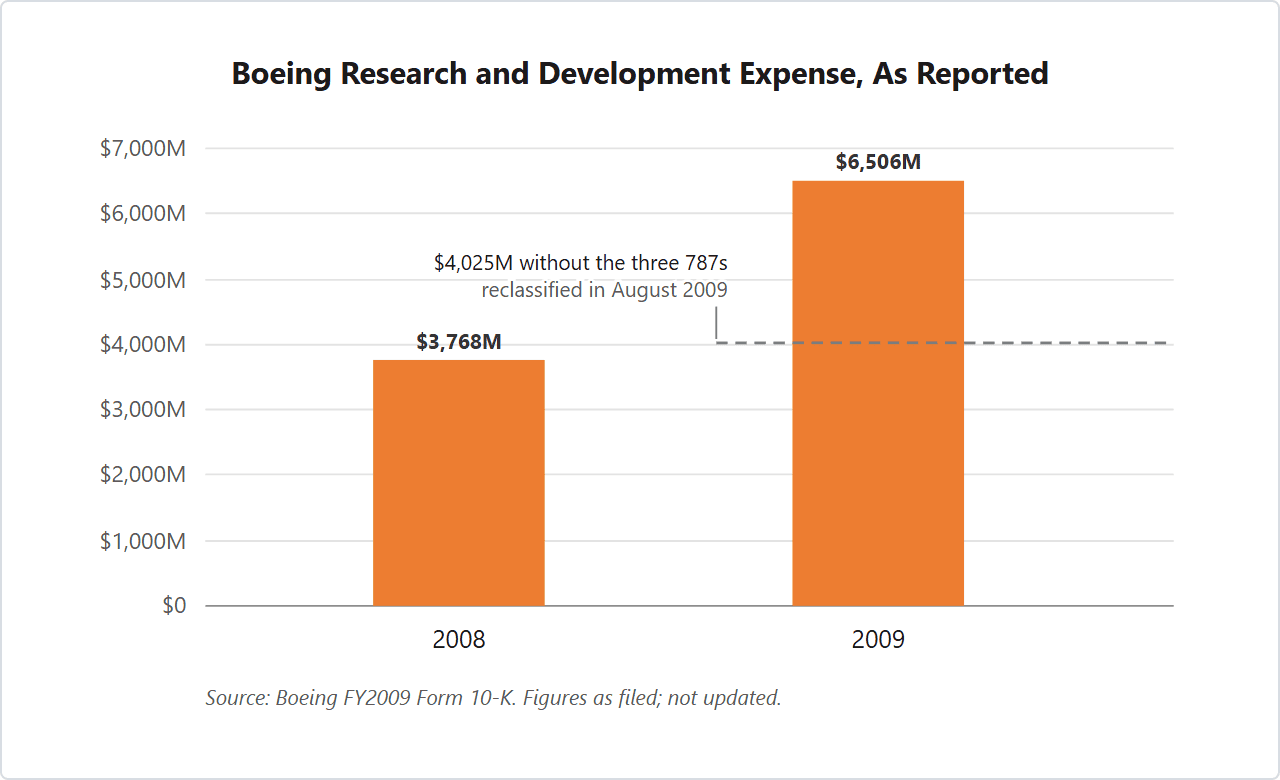
Boeing’s fiscal 2009 is a clean case, and it’s old enough that nothing here reads as a current view. Research and development expense went from $3,768 million in 2008 to $6,506 million in 2009. Net earnings fell from $2,672 million to $1,312 million.
A screen ranking profitability or earnings stability on those as-reported inputs sees a company coming apart.
Here’s what happened. In August 2009 Boeing determined that the first three 787 flight-test aircraft couldn’t be sold, so $2,481 million moved out of inventory and into research and development expense, with a further $212 million charged there afterward. Three airplanes moved from the balance sheet to the income statement.
Why a Single Correction Doesn’t Fix a Ranking
The obvious pushback is that you capitalize R&D and move on. That’s where universe-wide back-tests break. In a February 11, 2025 lecture at Emory & Henry, Joel Litman put it plainly. “Believe it or not, it’s 130 adjustments… What’s interesting is there’s only five or seven that matter.” Then the part that decides what happens to a screen. “The problem is it’s a different five at every company… So they took five pharmaceutical companies. It’s not the same five adjustments.”
A back-test ranks a whole universe at once. If the fixes that matter change from company to company, no single correction applied across that universe repairs the ranking. You either put every company on one basis before you rank anything, which is what Uniform Accounting does, or the ranking keeps sorting partly on accounting policy.
You can watch it happen at portfolio scale. Valens looked at the AQR Large Cap Defensive Style Fund, which held over $6 billion, and found that the average as-reported return on assets of its holdings sat right around 11 percent while the average Uniform return on assets (“ROA”) of those same holdings was 31 percent.
That gap doesn’t prove a factor works. It shows that a factor screen running on as-reported data can end up selecting partly for accounting treatment, which is not the factor anybody meant to buy.
Question Two: What You Can Do with the Number
Now the filter no vendor raises with you, because it constrains the buyer rather than the seller.
Back-tested performance counts as hypothetical performance under Rule 206(4)-1, the SEC Marketing Rule, adopted in December 2020 with a compliance date of November 4, 2022. The standard is explicit. Registered investment advisers “are prohibited from including any hypothetical performance in their advertisements unless they have adopted and implemented policies and procedures reasonably designed to ensure that the hypothetical performance is relevant to the likely financial situation and investment objectives of the intended audience of the advertisement.”
On mass distribution the SEC is blunter still. Advisers “generally would not be able to include hypothetical performance in advertisements directed to a mass audience or intended for general circulation.”
That said, the rule itself is rarely what catches a firm out. The surprise is whose advertisement the number becomes. Content you adopt becomes your advertisement, and the compliance burden travels with it whoever ran the test. On September 11, 2023 the SEC charged nine investment advisers over hypothetical performance on their websites without the required policies and procedures, with $850,000 in combined penalties, between $50,000 and $175,000 apiece. The vendor’s disclosure stays with the vendor.
Key points
- Sherman Research sells back-tested model blends only to advisors, from $495 to $695 a month.
- GuruFocus Premium Plus members can back-test a screen as far back as January 2006.
- A back-test on as-reported data ranks partly on accounting policy.
- Under the SEC Marketing Rule, back-tested results count as hypothetical performance.
Put the method to work every morning
FA Alpha Daily applies this to one company, metric, or market signal every morning, free for financial advisors.